
Thursday, September 24






|
Home > Leadership in the Real World Blog | |
![[Powered by Blogger]](http://buttons.blogger.com/bloggerbutton1.gif) Leadership in the Real World Blog
Leadership in the Real World BlogNotes, links, and inspiration about topics related to personal and leadership development. |
|
|
| |
"Punish Inaction"I've become a major fan of Dev Patnaik's book Wired to Care: How Companies Prosper When They Create Widespread Empathy I'm looking forward to interviewing Dev tomorrow for an upcoming People and Projects Podcast episode.Don't wait for the interview--get the book now and start reading. While prepping for the interview I came across what I expect to be my favorite quote for this entire month, from a recent article Dev wrote for BusinessWeek. The quote is credited to Stanford University engineering professor Jim Adams who said, "Good companies reward success, punish failure, and ignore inaction. Great companies reward success and failure and punish inaction." This hits on a common theme in both my interview with Michael Roberto about his book Know What You Don't Know: How Great Leaders Prevent Problems Before They Happen and in my discussion with Ralph Heath, author of Celebrating Failure: The Power of Taking Risks, Making Mistakes and Thinking Big: we too often seek first to punish failure instead of learn from it. Yet the even greater wisdom of the quote has to do with how we deal with inaction. You be the judge. How have you seen inaction most often handled? Tolerated? Expected? Ignored? Seriously. How many times have you said, "I thought of that years ago!" as someone makes money off an idea you had in the shower but went down the drain because you didn't take action. "Punish inaction." Do you want to excel at delivering projects and leading teams? Take those strong words to heart today. And don't just consider the inaction of those on your teams and the stakeholders you work with. You and I both need to look in the mirror to consider the inaction that has been holding us back. Do you want to make big things happen this year? Reward success. Enthusiastically learn from mistakes. And develop a disdain for inaction. P.S. Have you still not taken action on getting a copy of Dev's book? :) Labels: accountability, Books I Love, executives, innovation, learning, managing stakeholders, mistakes, podcast, project management, teambuilding, teams
posted by Andy at 1:52 PM 
| |
Leaders are Readers! Here's my Recommended Reading List
If you're like me, there are a lot of books you'd love to read but they just seem to stack up in a pile of good intentions. I don't consider myself a fast reader and I can honestly say that I don't particularly enjoy reading. But this I know for sure: leaders are learners. And one very beneficial way to further your learning is to fill your mind with books and other resources that will teach, challenge, and encourage you to be more effective and make a greater impact on your career, family, and the world. I'm often asked after keynotes and workshops for a list of recommended books. I have recently added a page on our website with book recommendations that I invite you to visit! Labels: Books I Love, leadership, learning, project management
posted by Andy at 5:32 PM
| |
Get Some Time Back in Your DayTwo of my favorite productivity and time management experts are hosting free learning experiences this week.Jason Womack: Goal Setting, this Friday 5/22, from 10:15am-10:45am Central. Click here for details on this free session. NOTE: Jason was a recent guest on my People and Projects Podcast. Click here to listen to the interview. Dave Crenshaw: Author of The Myth of Multitasking, this Friday 5/22, from 4:00pm-5:00pm Central. Click here to register for the free session. NOTE: Dave was my guest on the People and Projects Podcast back in February. Click here to listen to the interview. Enjoy! Labels: learning, podcast, time management
posted by Andy at 6:16 PM
| |
When the Company Cuts the Travel BudgetA recent survey indicates that some companies are putting the brakes on business travel. This has the potential to impact how you invest in your people when it comes to their personal and professional development.What are some options when buying airfare is not one?
 You can develop your teams while being a responsible steward of a limited budget. Give us a call and we can help match your budget with our services to help grow your staff. Labels: e-learning, learning, project management
posted by Andy at 12:07 PM
| |
The Tech Disaster AwardsI enjoyed reading Jake Widman's recent article about The Tech Disaster Awards: What You Can Learn from ITs Biggest Project Failures.Maybe it's just a relief that none of the listed belong to me or any of my clients! Regardless, the reason I invite you to read it is that even the big failures have lessons that can be drawn from them. Do we really need to be reminded that it's important to know what we're building before we start cutting code? Apparently so. 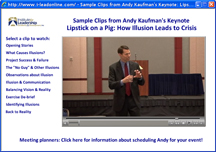 Enjoy the article. As a next step, here's a suggestion: Click here (or on the image to the right) to view a related clip from our popular Lipstick on a Pig keynote. Watch for the clip entitled Project Success and Failure. It has some valuable insights to help you and your team understand what leads to project failure (and how to better set your project up for success). Enjoy the article. As a next step, here's a suggestion: Click here (or on the image to the right) to view a related clip from our popular Lipstick on a Pig keynote. Watch for the clip entitled Project Success and Failure. It has some valuable insights to help you and your team understand what leads to project failure (and how to better set your project up for success).Here's to no Ig Nobel awards in your future! Labels: crisis, Information Technology, learning, Lipstick on a Pig, project management
posted by Andy at 1:55 PM
| |
Killer Whale Sized Opportunities to Teach and LearnWhat can you learn from "the new guy?"I've been enjoying Andy Jordan's blog on the People Side of Project Management. In a recent posting he talks about interacting with "the new guy" and how we can not only help them as mentors but that we can also learn from them in the process. In Amy Sutherland's book What Shamu Taught Me About Life, Love, and Marriage she relates that killer whale trainers remember that "every interaction is training." (click here for a post I made about this book). Every time trainers interact with Shamu they are teaching, whether they realize it or not. Both Shamu and the trainers are learning about what is expected, how to treat each other, consequences for actions, etc. I'm convinced that I miss killer whale-sized opportunities to learn each day because I'm not sufficiently paying attention. But when I do, those lessons can be more valuable than an expensive weeklong workshop. I remember when I finally got that the dirty little secret of business is that it's all done on relationships. Previously I wanted to believe that the smartest one wins. Or that the best argument wins. Or that filling out the "right" paperwork and following the "right" process was the secret to successfully delivering projects. But through the gift of a couple great mentors who modeled the secret of building relationships, I've been able to navigate situations that would have left me as Shamu Chow years before! Our interactions with the new guy (and the old guys!) are modeling how to look at the world of projects and business and people in a potentially different way. May we all be forces for good as we teach (and have our eyes and minds wide open as we observe). Want to become a more effective leader? Join our Leadership Fast Track Program to accelerate your ability to lead with confidence, take focused action, and achieve the results you desire.  Labels: leadership, learning, listening, managing up, mistakes, project management, project sponsors, teambuilding
posted by Andy at 1:46 PM
| |
What Shamu Can Teach You About Your BossOne of the dirty little secrets of managing is that, over time, you'll do more managing up and out than down. But that's easier said than done. What are some important lessons learned about managing up?I recommend Dan and Chip Heath's article in FastCompany entitled, "Your Boss is a Monkey". They take lessons from Amy Sutherland's book What Shamu Taught Me About Life, Love, and Marriage and apply them to managing "another irritable mammal: your boss." A couple observations that aligns with how we coach leaders:
Keep in mind that the "monkey" article's advice to "ignore the bad behavior" has limitations. There's wisdom in not over-reacting. Counting to 10 (or 100) has saved many careers! Yet "apparent indifference" does not always "smother the fire." In fact, for some bosses, it will pour fuel on the fire as it sends the signal that you don't care. Though the Heaths discount aligning styles and expectations as techniques, there is enormous leverage in understanding the art and science of such approaches. They are too critical to chalk up as "goody-two-shoe" training grovel. Want to learn practical skills on how to manage up more effectively? Join our Leadership Fast Track Program starting in June! Click here for details!
Labels: accountability, conflict, executives, influence, leadership, learning, managing up, personality styles
posted by Andy at 10:34 AM
| |
So Much To Do, So Little Time"So much to do. So little time."It's the theme song of most professionals these days. "How can I keep up with what's most important when there's just so much to do?" A recent CIO Magazine cover story laid out twenty of their best tips to invest 20 minutes wisely. Though they may overstate them as "20 minute miracles", the article has value for those seeking some relief from overloaded in-boxes and towering to-do lists. Some highlights include:
 So much to do? So little time? We can help you sing a different song: Get more done, with less stress! Check out our Leadership Fast Track Program for details. Labels: leadership, learning, networking, time management, work/life balance
posted by Andy at 3:14 PM
| |
Leadership Lessons from William A. OsborneA recent Crain's Chicago Business "Talking Business" episode included an interview with the Chairman and CEO of Northern Trust, Bill Osborne. I've had the distinct pleasure of facilitating training & offsite meetings for the Northern, as well as some executive coaching. You can often learn a lot about a leader by what people in their organization say about him or her. Here are some things I consistently hear people say about Bill:
Here are some notes from the brief video:
 Labels: accountability, executives, illusion, leadership, learning, listening, reality
posted by Andy at 4:22 PM |
|



|